Our ‘Conceptual Series’ is a project that gives us an opportunity to unleash our imaginations and dream up hypothetical spaces with aesthetics that we we might not typically get the chance to explore in our regular design work. Feel free to reach out to us with theme or style suggestions; we would love to visualize your ideas too!
Rooted in early Zen Buddhism, the Japanese expression ’Wabi-Sabi,’ is a harmony of two individual words: “wabi”, which signifies the understated beauty and melancholic feelings that coexist with living in nature , and ‘sabi’, which represents the acknowledgment and appreciation of the fleeting nature and beautiful imperfections of life. When combined, they form a profound philosophy that everything is imperfect, impermanent, and incomplete, which diffuses into every aspect of life, including the aesthetics of interior design. Wabi-Sabi spaces often feature asymmetrical pieces, handcrafted and/or constructed from unaltered natural materials, showcasing the beauty of straying from perfection. Aged elements such as rust, cracks, patina, are also frequently incorporated, serving as reminders of the inescapable nature of impermanence. Spaces designed with the Wabi-Sabi style are usually very sparse, in order to purposefully feel incomplete. For this conceptual concept.
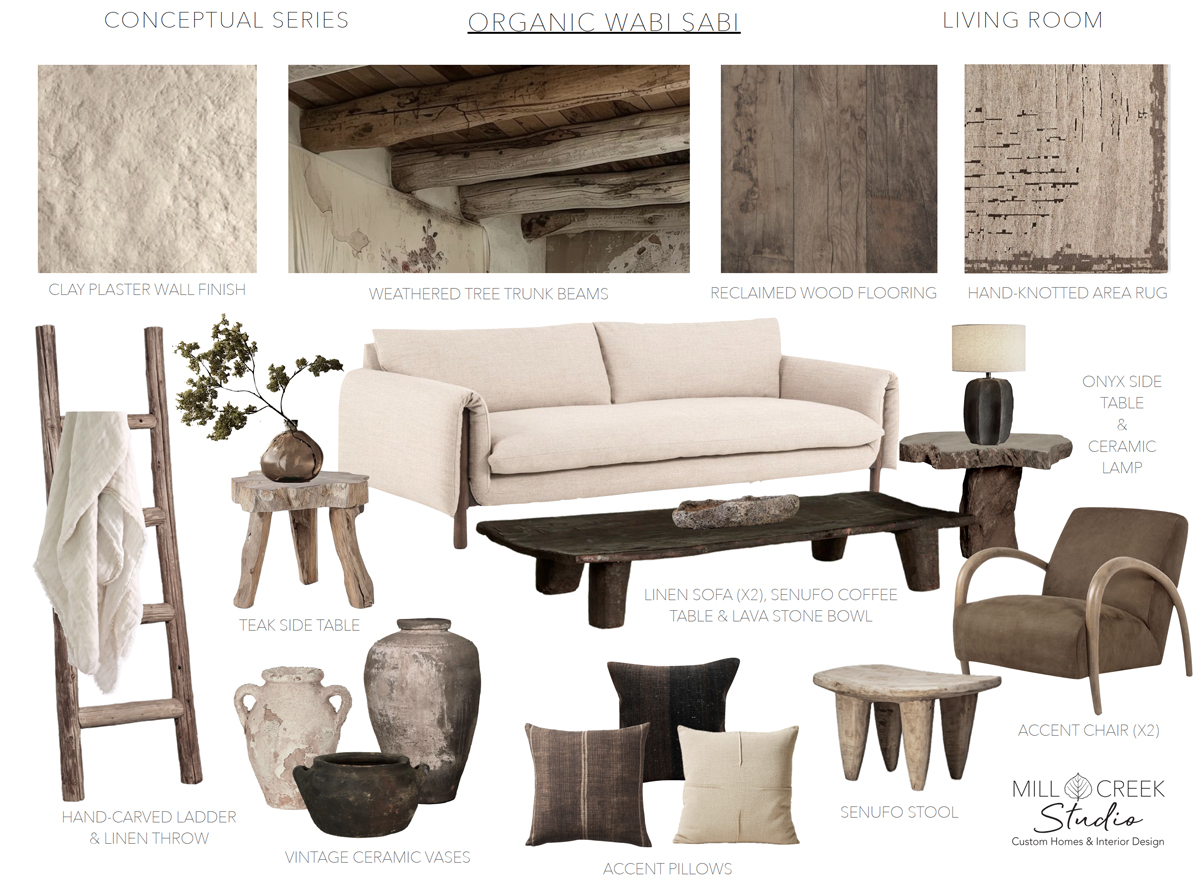
I had a lot of fun with this concept, as it is very similar to my personal design style! I lean mostly towards Wabi-Sabi, but I also love Organic Modern, so I really wanted to incorporate various organic materials such as wood, stone, and ceramic into this edition. I kept the colors simple and neutral, and only chose a few necessary decor items in order to achieve a somewhat sparse, uncluttered feel. The majority of the items are handcrafted and globally sourced—in fact, the ceramic vases are once-used and now-retired antiques from rural China, Morocco, and Turkey! Lastly, for structural elements, I decided on heavily textured clay plaster walls, rustic tree trunk ceiling beams, and a medium-toned reclaimed wood flooring. These components, each with their own unique imperfections, combine to create a cohesive and organic environment.
– Schylar Osborne